
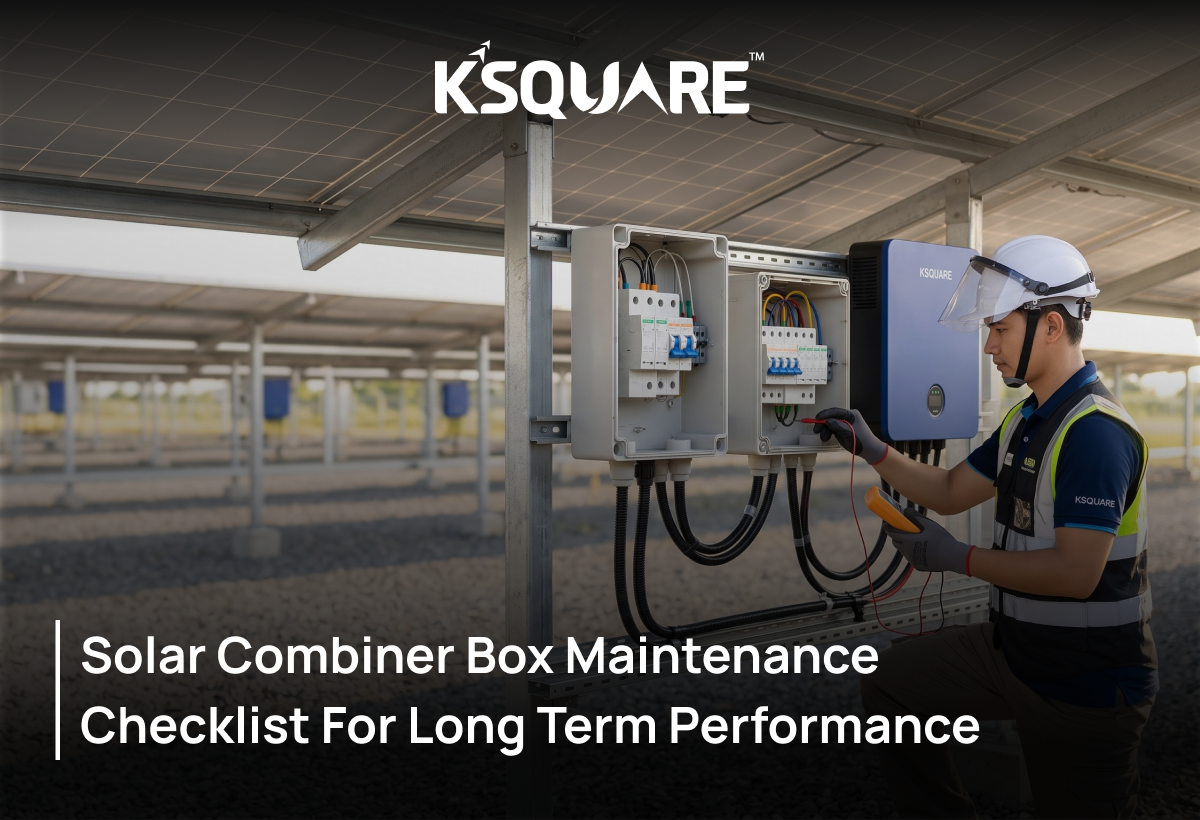
Introduction
A Solar combiner box is useful for structuring and protecting DC-side equipment in the photovoltaic system. They connect different solar strings in one place and house different protective and isolating devices. As with every electrical device, they require inspection and regular maintenance to be functional in the long term.
Accumulated dust, humidity, failed or poor connections, heat, and long-term component failure, influenced by exterior conditions, gradually degrade the boxes.
A preventive maintenance plan for a DC combiner box for solar systems can help detect component failures before they cause greater damage or electrical issues, including visual checks, connection inspections, and protection device testing.
What Is a Solar Combiner Box and How Does It Work?
A solar combiner box is a type of electrical enclosure designed to connect multiple PV strings into a single DC output. It usually lies somewhere between the PV array and the inverter, depending on the design and wiring scheme of the setup. An AC combiner box for solar systems can also be used on the AC side to consolidate and manage electrical connections based on the system configuration.
When strings of PVs are producing their DC outputs, if all the individual circuits are taken directly downstream, it can be a challenge to control the cabling. The combiner box gives you a consolidation point for all these connections.
Typical components that can be found within the solar combiner box are: string fuses, DC surge protection, isolators, busbars, and terminals. The actual makeup can vary depending on the number of strings, system voltage and current, inverter configuration, and also depending on the particular requirement of the system itself.
In addition to combining circuits, protection devices can also assist with electrical faults, and isolators do present the ability to shut the DC side off safely when required. The external box allows protection of internal components from all of the outside factors to the device.Understanding the solar panel combiner box working process helps explain how these components work together to combine, protect, and manage PV string connections.
Why Is Solar Combiner Box Maintenance Important?
Since combiner boxes exist within electrical loading, are outside and therefore at the mercy of outside temperature fluctuations, are within an electrical load itself, and are constantly generating from the sun, components could potentially experience strain. These could be sustained by routine maintenance.
Prevents Small Issues From Becoming Major Faults
Such conditions as a loose terminal and/or a damaged cable entry might seem insignificant when they are first discovered. Increased resistance due to bad connections might over time result in heating at localized points.
Detecting conditions of this nature prematurely makes it easier for maintenance teams to resolve the issues before causing equipment failure.
Supports Electrical Safety
Proper maintenance is closely connected with solar combiner box safety. All protective apparatus, insulation, and enclosures, along with any means of isolation, have to be in a satisfactory state.
Routine checks are likely to reveal things such as apparent damage, ingress of moisture or heat, or any other potentially unsafe condition
Helps Maintain System Reliability
A system whose combiner box is neglected could cause an outage for entire string levels. Good functioning of terminal elements, overcurrent protectors, and even the enclosure is crucial to better and steady performance of the system.
Extends Equipment Service Life
All components cannot be expected to age through inspection routines, but at least damage or undue strain resulting from bad contacts, dampness, contaminants, or loose fittings can be controlled.
It adds to all those maintenance tasks essential for long-term performance of solar electrical components.
Solar Combiner Box Maintenance Checklist: What Should You Check?
The maintenance checklist has also helped give the technician a structured approach to the inspection process. The actual frequency and procedures will still be performed according to the manual, circumstances, and electrical safety codes. Proper solar combiner box installation should also be considered, as correct installation can support safe operation and make ongoing inspection and maintenance more effective.
1. Inspect the Enclosure
First, physically examine the external condition of the enclosure. Check for damage; this could be in the form of cracks, dings, rust, faulty hinges, missing covers, or any apparent indication the enclosure has been abused.
For external enclosures, check to see if any dust or moisture has seeped in through doors, covers, or cable glands.
2. Check Cable Entries and Glands
Ensure that cable glands are secure and sealed tightly. If glands are damaged or are not snug, they will provide a passage of moisture and contamination to the equipment enclosure.
Examine the cables in the vicinity of the entry ports for abrasion, excessive bending, or damage, such as cuts.
3. Examine Terminals and Connections
Electrical looseness generates resistance, causing localized heating. Check the external and the most accessible connection points and terminals on accessible equipment for signs of looseness, staining, or corrosion, and heat damage when performing necessary maintenance shutdown.
Retighten or carry out necessary adjustments according to the manufacturer's operating and tightening instructions.
4. Inspect Fuses and Protection Devices
Verify the operation of the string fuses; check for visible damage or other signs that they may not be operating correctly. Likewise, examine any surge protection devices as required by the unit status indicators or manufacturer's guidelines.
Never substitute incompatible protection devices in an attempt to restore operation.
5. Check Isolators and Switching Components
Equipment associated with insulation needs to be visually checked for defects and any abnormal operation. Switching components need to be checked to ensure that they are functioning correctly and that they are in a fit state.
6. Look for Signs of Overheating
Discoloration, melted insulation, and terminals that show damage or bizarre marks near their electrical connections likely signal overheating.
None of these should be simply wiped or taped over; instead, the cause should be explored because it might result from loose wiring, overload, component degradation, or some other problem.
7. Remove Excessive Dust and Contamination
Conditions may be influenced by the collection of dust, particularly in highly polluted areas, and cleaning procedures will have to be related to the nature of the enclosure and the electrical components.
Under no circumstances should water or inappropriate cleaning agents enter electrical apparatus.
8. Verify Labels and Identification
Ensure the identification of input strings, output connections, protective equipment, and isolation points always remains visible.
Effective labeling will enhance the speed at which maintenance teams operate as well as reduce any confusion when problems arise during diagnostic procedures or repairs.
How Often Should a Solar Combiner Box Be Inspected?
There is no "one size fits all" inspection period for solar plants. The interval that applies depends on the manufacturer's instructions, operating environment, plant size and specification, operating system, maintenance program, etc.
Visual checks may be included as part of regular solar monitoring whilst more intensive electrical inspections may be scheduled during normal system shutdowns for maintenance. Plants subject to significant operating temperature, dust/dust levels, humidity, salinity (coastal effects), or an industrial environment may need closer inspections. Large solar plants (containing multiple strings and multiple components, etc.) may also need a more structured inspection program.
The main factor to maintain is a regular inspection program rather than leaving system checks until the equipment is visibly failed. Planned inspection would enable progressive degradation to be identified before system availability was impacted.
Common Solar Combiner Box Problems and Their Causes
Being aware of typical fault patterns could streamline diagnosis of the problem. The same symptom could be caused by any of a number of issues, and technicians should examine the fault situation rather than replace parts.
| Problem | Possible Cause |
|---|---|
| Fuse repeatedly fails | Short circuit, abnormal string current, incorrect fuse rating, or equipment fault |
| Enclosure shows moisture | Damaged seal, loose cable gland, improper closure, or enclosure deterioration |
| Terminal becomes discoloured | Loose connection, excessive resistance, or overheating |
| SPD indicator shows failure | Surge event, component ageing, or protection-device deterioration |
| One string shows low output | Module issue, cable fault, connector problem, shading, or fuse condition |
| Combiner box becomes unusually hot | Loose connection, excessive current, poor ventilation, or component failure |
| Corrosion is visible | Moisture exposure, environmental conditions, or damaged enclosure protection |
| Isolation switch behaves abnormally | Mechanical wear, electrical damage, or component deterioration |
This table is designed as a general guide only; it is not to be used as a substitute for performing correct electrical diagnosis.
How to Troubleshoot Solar Combiner Box Problems Safely?
Troubleshooting any PV DC system needs to be carried out with the necessary training, tools, and safety precautions. Solar strings will still have DC voltage when sunlight is present, so you cannot assume that simply because there is no DC inverter output, the DC is not live.
Start With Visual Inspection: There are some evident signs you need to inspect for: the insulation is melted or burnt, the terminals are burnt, corrosion or moisture, parts being broken, and the SPD or fuse indicator is off.
Review System Data: If the solar plant has monitoring capabilities, compare individual string performance and determine whether this problem is with one circuit or multiple circuits.One poorly functioning string might suggest a specific issue, whereas several strings are indicative of an issue with broader equipment/environment.
Follow Isolation Procedures: When installing, accessing, or maintaining equipment, first observe the approved site isolate/lockout procedures. Personal protective equipment and safe electrical working practices shall be employed by qualified personnel.
Test Before Touching: If any electrical testing work is to be undertaken, then the technician must use the correct rated instruments and the agreed site/manufacturer-approved procedures. Never think that a circuit is safe to touch just because a switch is off.
When Should a Solar Combiner Box Be Repaired or Replaced?
It is not always necessary for the entire enclosure to be replaced; many damaged fuses, terminals, SPD's, glands, and other replaceable parts can be rectified without the need for a complete enclosure replacement.
Replacement should be considered, though, if the enclosure has undergone heavy physical damage, extensive corrosion affecting integrity, internal components are obsolete or failing regularly, or equipment is no longer appropriate for the PV system. Common occurrences of regular faulting also need investigation prior to replacement; if the same fuse keeps blowing or the same terminal keeps overheating, further fault investigation should be carried out rather than just replacement.
When replaced, the selected part should match the electrical values, string configuration, degree of protection, installation site/environment, and inverter specification.
Best Practices for Long Term Solar Combiner Box Performance
Good maintenance is easier when it is supported by consistent operating practices. A clear routine helps teams track equipment condition and identify changes before they develop into costly failures. It also ensures that important checks are performed regularly rather than only after a performance issue occurs.
- Keep Maintenance Records: Enter inspection dates; identify the problems found, components replaced, test results, and remedial measures taken. These form a practical record, which can also be used to detect frequently recurring troubles.
- Follow Manufacturer Recommendations: When and where it is relevant, manufacturers' instruction procedures for inspection and testing should be strictly applied, especially in cases concerning devices, switching elements, and electrical tests.
- Maintain a Clean Installation Area: The surroundings of the enclosure must be free from excessive clutter and readily accessible to maintenance engineers. Maintenance engineers are able to access equipment without difficulty if there is free and clear access.
- Monitor Performance Changes: A deviation in string output and anomalous behavior of some equipment may serve as precursors. Regular checking of equipment performance in parallel with physical surveillance presents a more comprehensive assessment of the physical condition of the equipment.
- Address Issues Promptly: Don't overlook even a small indication of overheating or moisture entry, corrosion, or a deterioration in connections. The costs of correcting the fault early on will usually be considerably less than those incurred if the equipment fails later.
How to Choose the Right Solar Combiner Box for Your PV System?
Maintenance will start before the system is commissioned. Choosing equipment that fits with the job will decrease the probability of problems occurring during operation. Knowing how to select a solar combiner box can help ensure the selected equipment matches the electrical and environmental requirements of the PV system.
Number of PV strings, max DC system voltage, expected current, necessary protection, inverter arrangement, working environment, and protection level for housing should be the first considerations. For projects requiring dedicated DC-side distribution, a DC combiner box for solar systems can be selected according to the required string configuration and protection arrangement.
Equipment with the correct devices for the given conditions is a key element. A housing that has certain arrangements should not be assumed correct for a job just because it has the correct number of string inputs (see fig 4). Ksquare Energy provides different DC arrangements for solar projects; for example, their DCDB system includes 1-in-1-out, 2-in-2-out, MPPT-based, fuse, MCB, and DC SPD incorporated models, among others. Each arrangement suits a different system configuration: As they explain, they provide different DC distribution systems; in AC distribution systems, they also provide ACDB solutions for solar applications. Thus, DC and AC distribution should not be treated as separate components when it comes to them.
Why Choose Ksquare for Solar Combiner Boxes?
Ksquare Energy, an Ahmedabad (Gujarat)-based solar products manufacturer and supplier, manufactures and supplies components like DCDB, ACDB, cables & wires, electric panels, enclosures, solar structures, and associated solar electric products. "The company says it has secured its position in all parts of India through quality products and prompt service."
Such availability of products for a solar project team (e.g.) is worthwhile, since both the DCDC and AC distribution equipment are part of a connected electric system. The interaction of all components is important from the system perspective, rather than from the individual component box perspective of a separate electrical product.
Ksquare also manufactures DCDBs. With available fuse types and MCB types, as well as DC SPD-integrated DCDBs for different settings, a user could select the appropriate DCDB to be used. With the availability of Ksquare's ACDB also, the solar project team could think about both halves of the electric distribution system.
However, as a client is short-listing a manufacturer, selection shouldn't be just dependent upon availability of the product. Technical specifications, components used, tests performed, enclosure specification, and environmental appropriateness should be assessed while selecting a manufactured product.
