
Introduction
Make mistakes in the solar DC combiner box, and you will realize this the hard way through a fuse that keeps popping out, a terminal that gets brown due to overheating, or an inspector who refuses to sign you off. Get it right, though, and you will forget about its existence as it's supposed to do. This box is located outside the solar array and connects all panel strings in one; it also protects each string, sending clean DC power to the inverter.
None of that choice is guesswork, though. It really boils down to four numbers, how many strings, how much current, what voltage, and how rough the site is on an enclosure. Sort those out and everything else falls into line. So that's what we'll do here, one number at a time, with the usual traps flagged along the way, so you walk away with a box that fits your array rather than one that was simply in stock.
What Is a Solar DC Combiner Box and Why Is It Used?
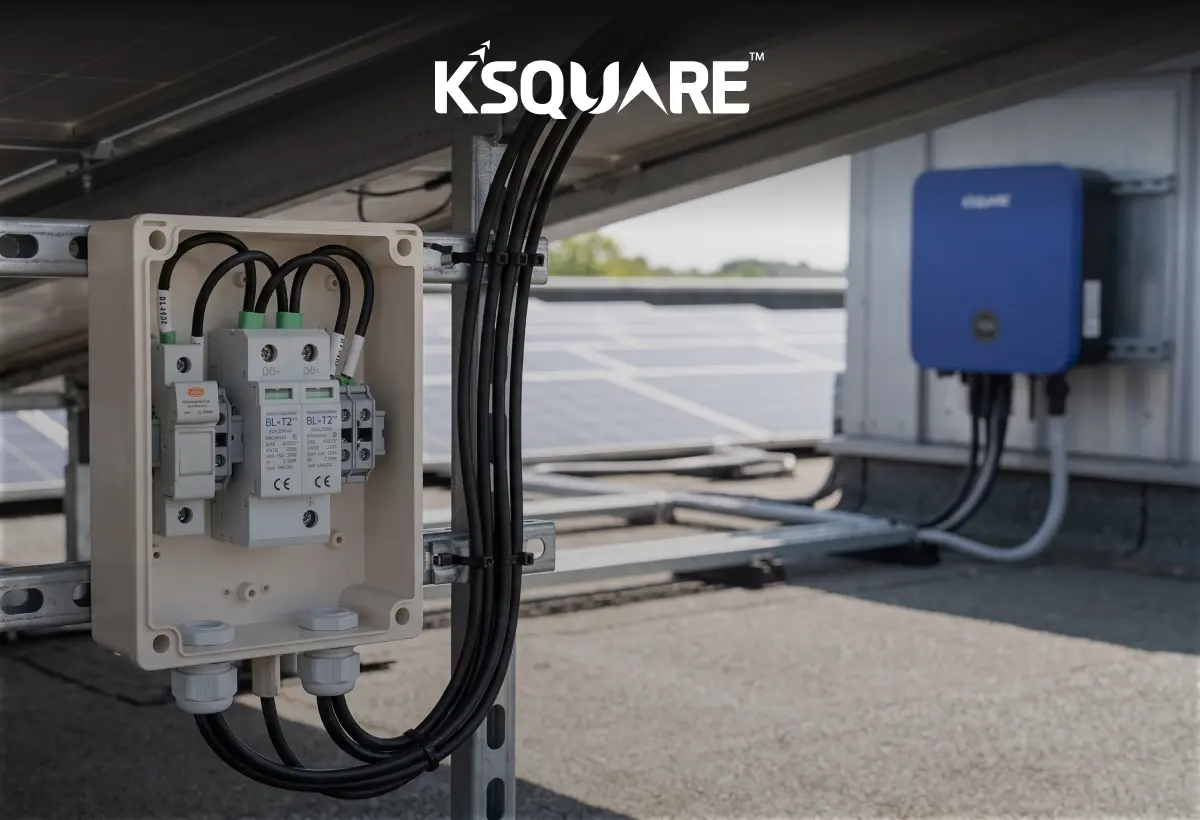
In plain terms, what is a dc combiner box? Picture a box out at the array that takes the output from several panel strings and merges it into one line running to the inverter. Instead of dragging a separate pair of cables from every string all the way back, you land them here and send one feed on from there.
Half of it is just keeping things neat. A dc combiner box trims your cable runs, and that shows up as real money and real hours saved on site. The other half is safety. It pulls your string-level protection into one spot you can actually get to, and it hands you a single place to isolate the array when you need to. Push past two or three strings and going without one stops making much sense.
How Does a DC Combiner Box Work in a PV System?
Follow the power through and it makes sense fast. A string comes in, hits its own fuse. Does the same for the next, and the next. All those positives end up on one busbar, the negatives on another, and that meeting of the busbars is the combining, there's nothing more mysterious to it. The one merged output then clears the surge protection device and the DC isolator on its way out, so what you're left with is a single protected feed and one switch that drops the whole array.
That's the short of it. For the full run through the internal path, and how each part behaves, we've already laid it out here: How Does a Solar Panel Combiner Box Work
What Factors Should You Consider When Choosing a DC Combiner Box?
Before you so much as glance at a product page, pin down what your array actually asks for. Five things really steer this, and they feed into each other.
- String count. Your starting point, since it fixes how many fused inputs you’ll need.
- String current and total current. These set your fuse and isolator ratings, so they matter more than anything else on the list.
- System voltage. Whether you’re on 1000V or 1500V decides the voltage class.
- Site conditions. Heat, dust, and salt air all push you toward a tougher enclosure.
- Room to grow. A spare input now beats a full swap next year.
Settle these first and the shopping part gets easy. Leave them vague and you’re fitting a box to a hunch.
How to Calculate the Right DC Combiner Box Size and Current Rating?
This is the bit where a dc combiner box for solar either slots in neatly or fights you every step, so a few minutes of maths earns its keep. Grab each string's short-circuit current, the Isc, off the panel datasheet. String fuses usually sit at about 1.5 times that Isc, enough to catch reverse current without tripping every time a cloud passes.
Then total up the current from all the strings landing in the box. You want the isolator and busbar carrying that figure without breaking a sweat, which generally means rating them somewhere around 1.25 to 1.5 times the combined current rather than parking them right on the line. Size it like this and the box runs cool and protected instead of permanently stressed. And don't forget heat derates everything, so a rooftop baking through a Gujarat May wants a touch more margin than a spec sheet dreamed up in an air-conditioned office.
What DC Protection Devices Should a Combiner Box Include?
Three protections carry the load here, and a proper dc combiner box solar build cuts corners on none of them.
- DC Distribution Box, combining solar panel string outputs and providing DC-side protection and isolation.
- String fuses. One per string, stopping reverse current before it chews up a string or a module.
- DC surge protection device (SPD). Type 1 or Type 2, sitting between the buses and earth to throw lightning and switching surges safely out of harm’s way.
- DC isolator. Your means of killing the array for maintenance.
- Proper earthing. Holds the whole thing up, because every one of those devices is only half-useful without a solid path to ground.
Put those four together and you've got a box that protects, not just one that combines.
How Many String Inputs Do You Need in a DC Combiner Box?
Your string count isn't a choice so much as a readout from the array design, specifically how the panels group into strings and how those strings feed the inverter's MPPT inputs. Count the strings physically landing in this box and there's your floor.
Now it's worth paying for: size up when the budget stretches to it. These boxes ship in standard builds, commonly 4, 8, 16, or 24 inputs. Say your array runs 14 strings, a 16-input box hands you two spares for whatever you bolt on later. Cramming every last input full looks tidy on paper, right up until the system grows and you're buying a whole new box. A spare input or two is about the cheapest insurance in the whole install.
What Voltage Rating Should You Choose for a Solar DC Combiner Box?
Voltage is the one rating you really can't eyeball. The box has to cope with your system's highest open-circuit voltage, the Voc, and here's the trap that catches people, panel Voc climbs as the temperature drops. Which means your worst case isn't a scorching afternoon at all, it's the coldest morning of the year.
On the ground, most homes and commercial sites run 1000V DC, while the bigger commercial and utility arrays are leaning more and more on 1500V DC for the efficiency. Match the box to your calculated maximum Voc at the lowest temperature you'd realistically see, and keep a margin on top. Skimp on it and you're risking insulation breakdown and arcing, and a DC arc is not the sort of fault that politely sorts itself out.
What Enclosure and Environmental Protection Features Matter?
Whatever's inside is only as safe as the shell around it. And since a dc solar combiner box spends its life outdoors, nearly all of them do, the enclosure has a genuinely hard job.
What you need is either an IP65 or IP66 rating to protect from dust and pouring rain and exposure to a UV-resistant material that won't deteriorate quickly in one summer or two and a material that provides thermal stability that keeps the radiant heat from baking the internals. Coastal or humid site? Corrosion resistance climbs right up the priority list. One tell worth chasing: manufacturers who build their own enclosures usually have a much firmer grip on all this than the ones assembling whatever shell came cheapest that week. Worth asking before you commit.
DC Combiner Box Installation and Maintenance Best Practices
Even a flawless box comes undone if it's thrown in carelessly. Check the strings are open or dead before you start, because these things carry live DC the second daylight hits the panels. Hold your polarity, positive to positive, negative to negative, since a flipped string is both an old classic and a genuine hazard. Torque each terminal to spec with an actual tool rather than a confident wrist, and seal every gland so the weather stays outside.
Where it goes matters as much as how it's wired. Keep it out of direct sun and well clear of anywhere water pools in the field, ideally tucked in the shade under the modules, since heat and damp will wear down even an IP-rated box given time. On upkeep, run an eye over the terminals, the fuse and SPD status, the isolator, and the sealing every so often, and make that "so often" more frequent on dusty, coastal, or furnace-hot sites.
Common Mistakes to Avoid When Selecting a Solar DC Combiner Box
The same handful of slip-ups show up site after site, and every one is dodgeable. Most of them trace back to the same root cause: skipping the sums at the start and trusting a hunch instead. Get the numbers down once, properly, and the list below mostly takes care of itself. Here’s what to watch for:
- Under-rating the voltage. Someone forgot Voc climbs in the cold, so size to the coldest morning, not the hottest afternoon.
- Wrong fuse sizing. Too small and it nags you with trips, too big and it protects nothing, so work it from Isc every time.
- No spare inputs. Feels economical until expansion day lands you with a full replacement.
- A bargain enclosure. Saves a little now, then splits or leaks after its first real monsoon.
- Dropping the SPD. Shaves the quote, but leaves your whole array bare to the next strike that wanders past.
Nearly all of this traces back to skipping the sums at the start, so do the numbers once, properly, and the list mostly takes care of itself.
How to Select the Right DC Combiner Box for Your PV System
Tie it all together and selection is really one short checklist, run in order. None of it is complicated once the numbers are in front of you, and each step sets up the next. Work through them top to bottom and you’ll land on a box that fits the array rather than one you’re hoping will do. Here’s the order:
- Match the string count to your array. Include a spare input or two for whatever you add later.
- Size the fuses off string Isc. And size the isolator off the combined current, both with margin.
- Set the voltage from your coldest-morning Voc. That worst case decides your 1000V or 1500V class.
- Confirm every protection device is there and rated right. Fuses, SPD, isolator, earthing, no gaps.
- Pick an enclosure that suits what your site actually dishes out. Heat, dust, rain, or coastal air.
For a wider walk-through covering combiner selection on both the AC and DC sides, this one pairs nicely alongside it: How to Select the Right Solar Combiner Box. And if you’d sooner have the numbers checked against your real array than your own spreadsheet, Ksquare Energy builds DC combiner boxes out of its Ahmedabad facility, rated correctly, enclosed properly, and customisable across string counts and voltage classes, made for what an Indian PV system genuinely runs into.
