
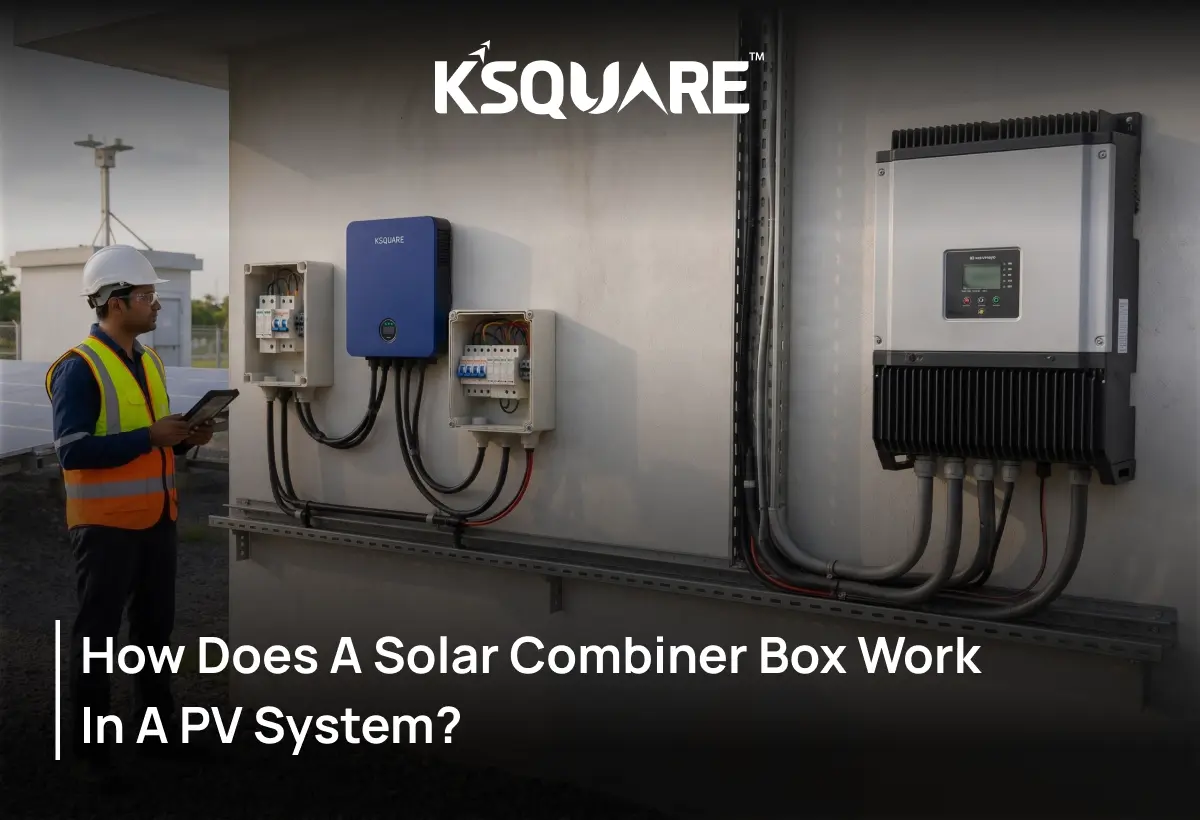
If you've ever looked at a fairly standard sized solar array and wondered how the individual panel strings all end up as one neat little cable going to the inverter, the answer is a small grey box doing a very quiet job in the background. So how does a solar combiner box work and why does nearly every commercial and utility system have one?
In short it takes the DC output from a number of panel strings, combines them into a single feed and protects each string in the process. It's not exactly the most exciting piece of kit and most people will never really give it a second thought until something goes wrong. Understanding what it does and how it does it tells you a massive amount about how the PV system as a whole remains safe and efficient. This guide looks at what it does, what it's made of, how the string combining actually works, the protection it provides and how it's different from a simple junction box.
What Is a Solar Combiner Box and What Does It Do?
A solar combiner box is an enclosure on the DC side of the system (between the panels and the inverter). Its job is very simply to combine. Multiple panel strings feed into it and there's a single combined DC output coming out the other side which then goes to solar inverter.
Imagine the alternative. No combiner box and you'd have a separate pair of cables from every string all the way back to the inverter. On a 12 or 16 string system that's a tremendous amount of cable, a tremendous amount of labour and a tremendous amount of clutter. The solar power combiner box completely eliminates that and brings it down to one clean feed. It also does something that the individual cables can't do which is to isolate each string and give you a single point at which to switch the whole array off. So it's obviously a cost saving in terms of cable and labour but it also makes the system far safer and a whole lot easier to maintain.
Solar Combiner Box: Purpose and Role in a PV System
The real purpose of the box becomes clear if you look at where it sits in the chain. It's the first major junction after the panels, the point at which all the dispersed output of the array is collected together prior to anything else being done to it. That position gives it three jobs at once.
- It consolidates. A number of string inputs become a single output, reducing both cable runs and cost.
- It provides protection. Each string has its own fuse and the whole array is protected against surges at one point.
- It isolates. A single disconnection will allow the array to be safely de-energised for maintenance or in the event of an emergency.
The combiner box is where you're most likely to find a fault (it's the choke point). If a string is underperforming or tripping you'd go straight to the combiner box. For a more detailed look at the internal path see our guide on how does a solar combiner box work? In a properly designed PV system that's precisely why the combiner box is there rather than an optional extra.
How a Solar Combiner Box Works: From PV Strings to Inverter
Here's the bit that most people actually want to get their heads around. Run the power through the box and the whole thing becomes perfectly clear.
Each string generates DC and has its own cable running into the box. The first thing the string comes up against is its fuse which is on the line ready to protect it. The string positive then feeds into a common positive busbar and the string negative into a common negative busbar. That's the combination point itself, a dozen separate inputs all coming together as one circuit, physically joined up on a strip of copper.
That combined output isn't quite ready to go. It first passes through the surge protection (which is between the busbars and earth and is there to safely divert any voltage spike to earth). It then goes through the DC isolator (the switch which allows you to break the whole circuit at any time). Only after that do the two feeds combine and leave the box to go to the inverter. The sequence is: strings in, fuses, busbars, surge protection, isolator, output out. Same sequence every time.
Key Components of a Solar Combiner Box
A solar system combiner box is made up of a very small number of components, each with a very clear function in that process:
- String fuses (one per string) to protect the string against reverse current during a fault.
- DC Surge Protection Device (SPD). Type 1 or 2, wired between the busbars and earth to divert lightning and switching surges.
- DC isolator / disconnect. Rated to the combined current so the array can be safely switched off for maintenance.
- Busbars. Properly rated copper with the individual strings all physically joined together.
- Cable glands and terminals. Sized and sealed for clean, secure cable entries.
- String monitoring (optional) On the more sophisticated units you'll have sensors to monitor the string current and flag a weak string.
The quality of the internals is what will ultimately determine whether the box runs cool and reliably for its full design life or starts to fail on its own after a season or two. A loose fuse holder or an undersized busbar is frequently the cause of a box that ends up cooking itself after a couple of seasons. That's why Ksquare Energy build their combiner boxes with properly rated internals which are designed to last the full service life rather than just pass inspection on day one.
PV String Combining and Electrical Connections
It's worth taking a moment to think about the connection process as the electrical mind involved is absolutely vital for anyone actually doing the job. The theory is straightforward really. You're just connecting strings in parallel. Each string is operating at the system voltage which is the voltage of the series connected panels. So when you connect them in parallel the voltage stays the same and the current is multiplied. If you have ten strings all operating at the same voltage you end up with one output at ten times the current.
That's why the ratings in the box go up with string count and the busbar and isolator have to be sized for the total combination rather than a single string. The connections themselves are very strictly polarised (positive to positive busbar, negative to negative) as a reversed string can drive fault current the wrong way and effectively kill the protection. Clean, properly torqued connections are of course essential as a loose or high resistance joint at the busbar is a very common cause of heating and lost output. It all works perfectly well in practice and if it's done correctly the combination is totally invisible; power just comes in from many strings and goes out as one.
Protection Features in a Solar Combiner Box
Protection is the primary reason for the box's existence and three of the features confirm that.
String fuses come first (each string gets its own, rated at approximately 1.5x the string's short circuit current to pick up any reverse current before it can damage the string or the module). Then we have the DC surge protection device which is situated between the busbars and earth and is designed to divert the energy of a nearby lightning strike or switching surge away from the inverter and Solar LT panels. Third is the DC isolator which gives you a proper way of de-energising the array should you need to do any service work.
Underpinning all three is proper earthing. Each of those devices is only half the job without a good low impedance earth path and that's why in a proper installation you'd treat the earth bonding in exactly the same way as you would the live wiring. That's what turns a box that's just a box into a box that actually protects the system it's in. That's the Ksquare Energy standard we build to, treating the protection chain and the earthing as the fundamental part of the box rather than as ancillary.
Solar Combiner Box vs. Junction Box
This is where people tend to get confused and it's important to be very clear about the distinction. Both a combiner box and a junction box are enclosures which bring the cables together, so they look the same on the surface. The difference is in what's inside.
A plain junction box is just a box to join or route conductors, in effect a connection point. A combiner box does that as well, but it also provides the protection and control (string fuses, surge protection device and isolator). So every combiner box is a junction box, just not every junction box is a combiner box. The combiner gets its name from the fact that it combines and protects rather than just connects.
In practice the line is a bit blurry. On a small system you could very well have a single enclosure that does both the combining and the basic DC distribution and people will use the terms quite loosely. On a larger plant the functions will be kept separate for clarity and for the ease of maintenance. The simple test is if the box has fuses, surge protection and an isolator in it then it's a combiner regardless of what's on the lid.
Applications and Benefits of Solar PV Combiner Boxes
So where do you actually find combiner boxes for solar system installs and what do they offer? The pattern is scale.
- Commercial rooftops. Multiple strings land in one or more combiner boxes, tidying up the DC wiring and making commissioning a whole lot easier.
- Ground mounted and utility plants. Those are the ones that are taking dozens of strings across the field and feeding that aggregated output into the central inverters (often with string monitoring as part of the package).
- Larger residential systems. Used when the string count gets beyond what is reasonably to feed directly into the inverter.
Benefits apply to all of them. Fewer cable runs and lower material cost, the protection and isolation all in one accessible box, easier fault finding at a single point and with monitoring you can get an early warning of a string starting to underperform. Small residential arrays with just one or two strings will often dispense with the box entirely as the strings can feed the inverter directly. The rule of thumb is really quite simple: the more strings you have in your array the more compelling the case for a combiner box.
